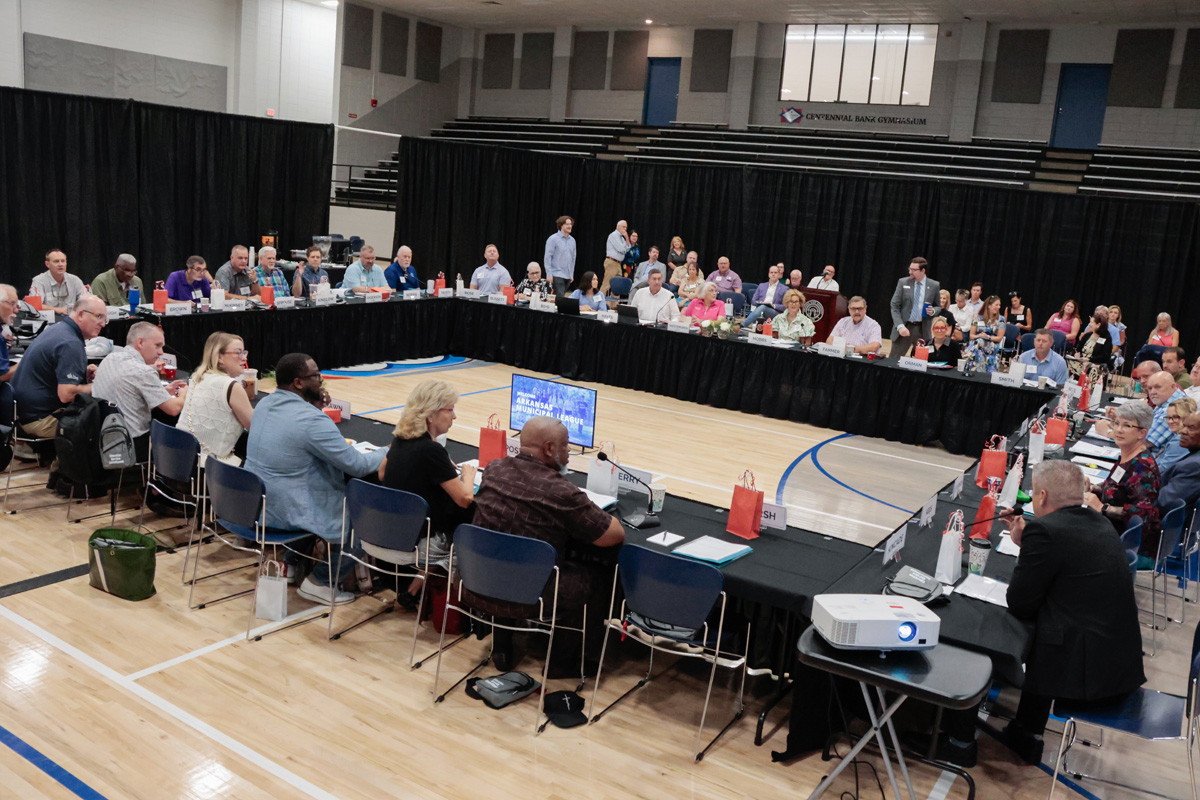
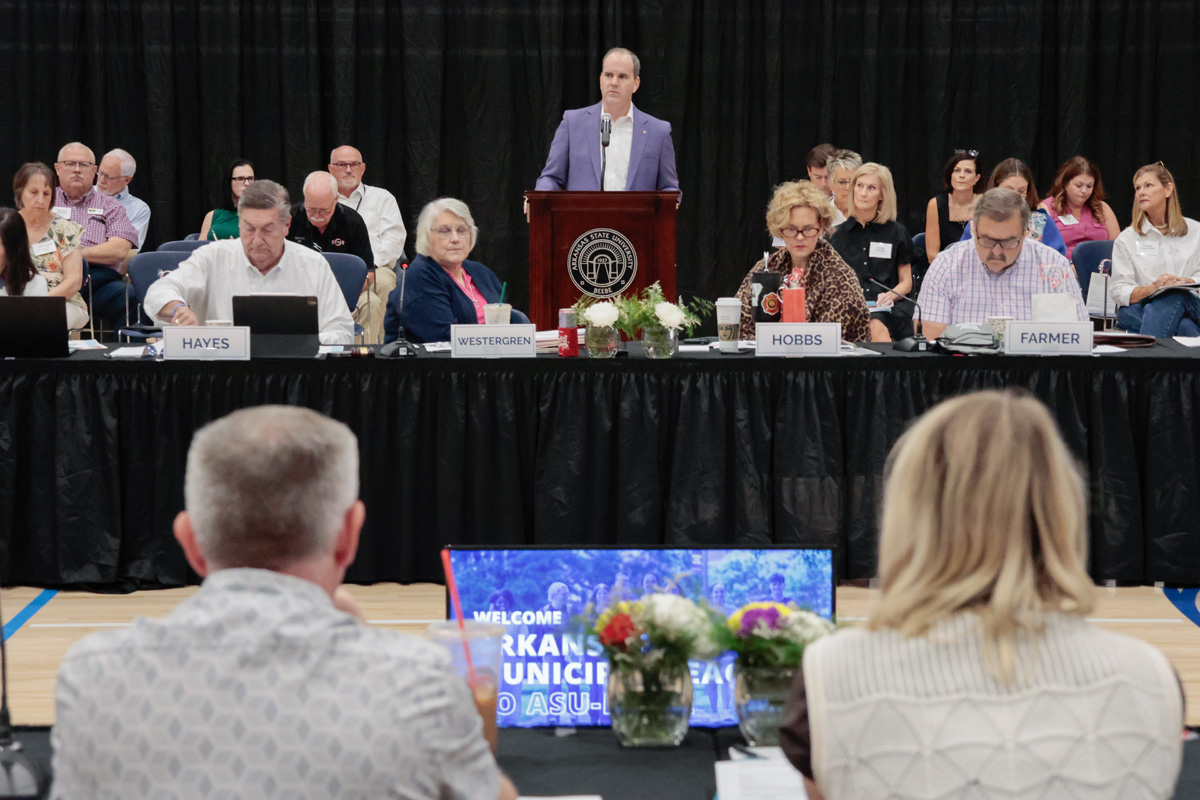
The Arkansas Municipal League’s Executive Committee, past presidents, advisory council chairs and optional benefit program board members met in Beebe August 19-20 to set the organization’s agenda in motion for the coming year at the Annual Planning Meeting. The meeting, which follows the Annual Convention each year, gives the League’s governing bodies the opportunity to review the previous year’s activities, examine legislative priorities, strategize for the coming year, and implement the organization’s policies and goals.
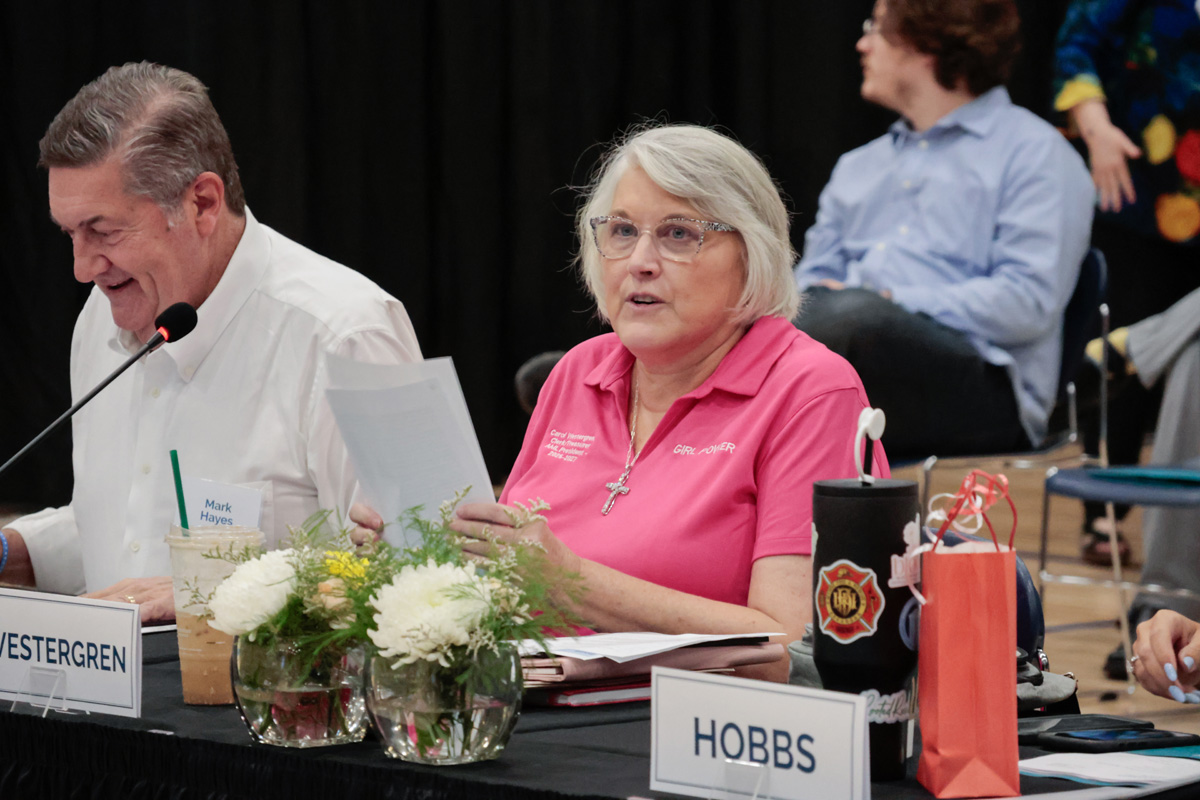
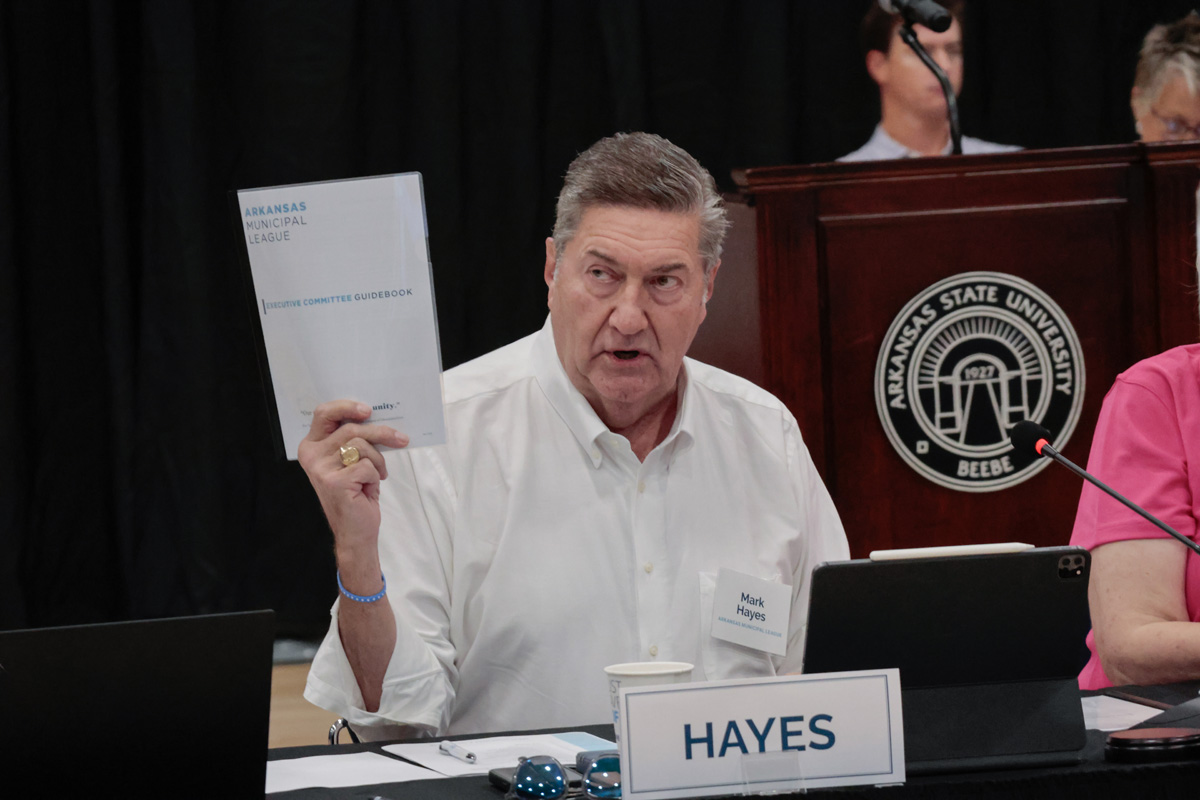
Beebe Clerk/Treasurer and 2026-2027 League President Carol Westergren called the Executive Committee to order the morning of August 20, and after the approval of the minutes from the group’s May 20 meeting, Executive Director Mark Hayes presented his annual report, outlining the status of League’s programs and providing an overview of the organization’s mission.
Again this year, all 500 cities and towns in Arkansas are members of the League, and that’s important, Hayes said. “We’re at 100% membership. We started doing that years ago. It requires some meetings at gas stations and grocery stores and front porches to get the final check sometimes, but we get it done and I’m very proud of that. Again, our strength is our unity.”
Participation in the League’s benefit programs—Municipal Vehicle and Property, Health, Workers Comp and Legal Defense—funds the organization’s broad operations. The annual membership dues are kept purposefully low, or de minimis, as Hayes put it, and the committee voted to keep the same dues structure for the coming year: a $40 base charge plus 35 cents per capita with a 7-cent per capita credit for participation in each of the five optional programs.
The League also has 135 limited-service members, up three from the previous year, which include counties, housing authorities, water associations, solid waste districts and other entities that participate in one or more of the optional benefit programs. The Executive Committee voted to retain their existing rates as well. The base membership rate for counties and planning and development districts is $1,000 and the rate for other municipal entities is $500.
For detailed information on the League’s service charge, fees associated with the optional programs, turnback estimates and the latest APERS multiplier, please refer to the executive director’s annual budget memo in this issue on pages 22-23.
For the updated summary of Municipal Property and Vehicle Program coverages, limits and deductibles, see pages 24-25.
Training is a large part of the League’s mission, and the Arkansas Civic Education (ACE) Program participation continues to grow, Hayes reported. New this year is the addition of Mandatory Treasurer Training. State law now requires all municipal treasurers or primary financial officers to receive eight hours of training in their field, and the League has worked with Legislative Audit to create the coursework to comply with the mandate. It’s been a “heavy lift,” Hayes said, but as of the planning meeting, 200 of 500 cities and towns have completed the training, which is available online through the League’s ACE Program at no charge. For more information, please email askmtt@arml.org.
During last year’s Annual Planning Meeting, the Executive Committee put its support behind what was then Senate Joint Resolution 15. SJR15 is now on the November General Election ballot as Issue 3, referred to the state’s voters by the Arkansas General Assembly. This year, the committee reiterated its support of the package of resolutions passed during the Annual Convention in June, including support for Issue 3, which would give cities and towns more options to promote local economic development efforts, including retail. It’s also an acknowledgement of the importance of local control, a hallmark of our core values, League General Counsel and Legislative Director John Wilkerson said. “It’s the legislature telling us that we are already the drivers of economic development,” he said. “What they’re saying is local control is what matters most. Cities’ and towns’ ability to control their economic fate and their future of economic development is the most important thing.”
If passed by the state’s voters, guardrails established in the implementing legislation will be “incredibly important,” Wilkerson said. “We want cities and towns to be educated on how best to use it, and the guardrails in the legislation I think are the best first step.”
The committee also voted to support Issue 4 in November’s General Election, which would authorize the Arkansas Natural Resources Commission to issue up to $500 million in bonds to support local water and wastewater projects.
With preparations for the coming 2030 Census already underway, it’s essential that cities and towns begin to work now toward getting an accurate count, including establishing an official or staff member to be the census point person for the municipality and participating in the Local Update of Census Address (LUCA) program to ensure that every person in the community is counted. To that end, the Executive Committee voted to support Arkansas Counts, the official coalition of government entities, nonprofits, faith-based organizations and other stakeholders dedicated to getting an accurate count in 2030. To learn more, visit ar-counts.org or email info@arkansasimpact.org.
In other news from the meeting, the League’s successful field representative program will soon be expanding in south Arkansas. JoAnne Bush, who has served in a part-time capacity based out of Lake Village, will transition to full time to better serve the southeast Delta region. The League also plans to add another field rep to the team early next year.
Hayes closed his executive director’s report with a word of appreciation for all the state’s city and town officials who serve their communities with dedication. He shared a quote from a former city manager, Matthew Watkins, who now serves as a consultant to the New Jersey League of Municipalities.
“I think it is an accurate statement, particularly in this day and age: ‘Public service is a vocation and an honor given to the few who have the courage to stand up in the face of unmerited criticism to serve the greater good of their community.’ And in case you didn’t know it, that is each and every one of you. Our state is better because of what you do every day.”