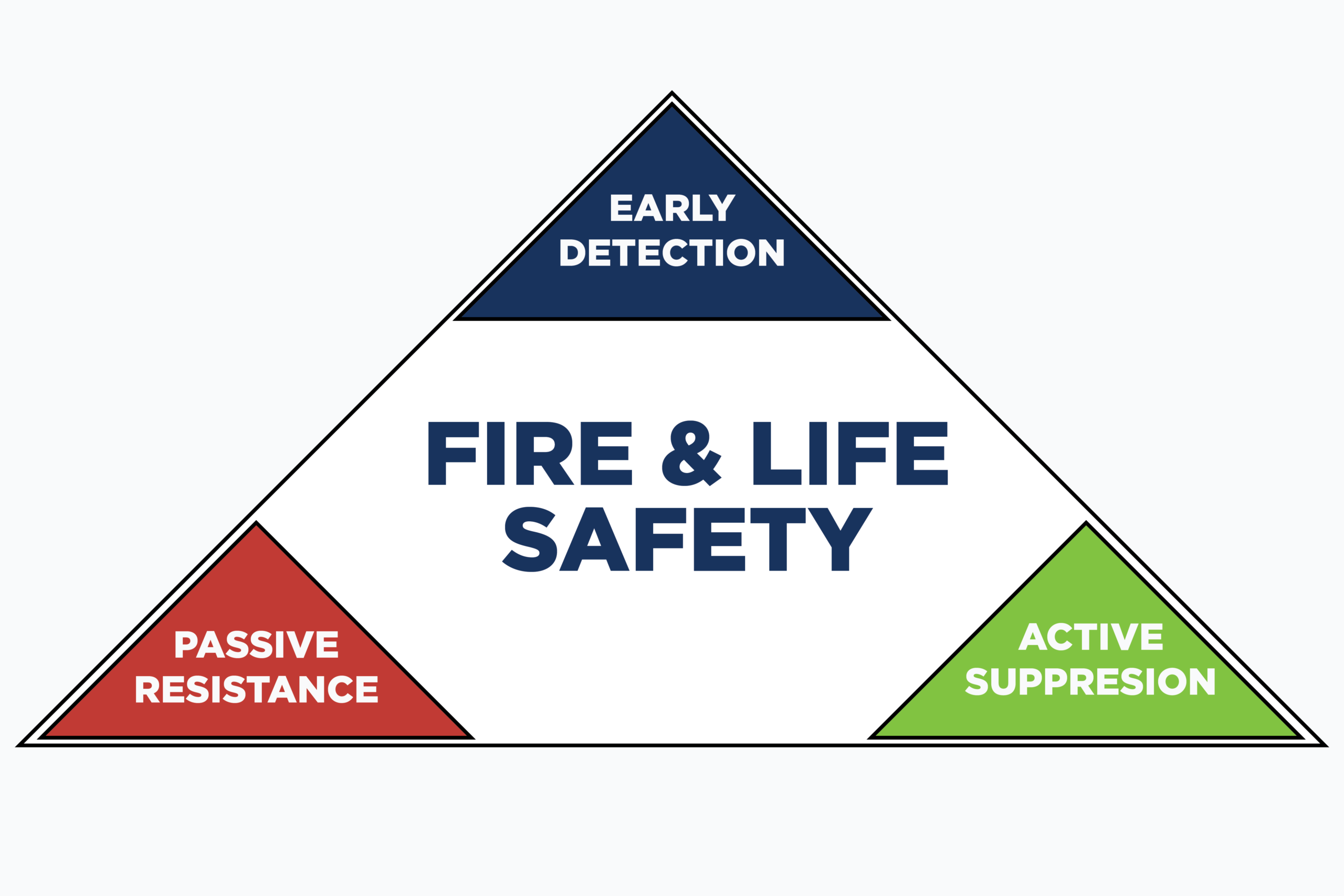
For developers, residents and municipalities, the installation and proper inspection of firestop systems are fundamental components of a comprehensive fire-safety strategy. Firestops help prevent or slow the spread of fire and smoke, giving occupants more time to evacuate and first responders a better chance to contain the fire. Moreover, properly installed and inspected firestops can minimize property damage while also providing accountability and documentation that the passive fire protection elements were installed properly.
A fire-safe building design must address more than just sprinklers and alarms; passive fire protection through compartmentalization is equally important. Compartmentalization is a core principle of passive fire protection that divides a building into smaller, fire-resistant zones to limit the spread of fire, smoke and toxic gases, providing critical time for evacuation and firefighting efforts. For a rated assembly to perform as intended, every penetration, including mechanical, electrical and plumbing services, must be sealed and fire-stopped correctly, because even small gaps can compromise the fire-resistance of the entire barrier.
Firestop is the barrier that seals penetrations and joints in fire-rated walls, floors, ceilings and perimeter barriers and, when installed properly, prevents fire, smoke and toxic gas from traveling through what would otherwise be unprotected holes.
With Arkansas’ adoption of the 2021 International Building Code in 2023, many jurisdictions expanded firestop-inspection requirements. Key changes include:
The requirement for third-party inspections of firestop installations for any residential-use buildings with a classification of Group R that have occupancy loads greater than 250.
Mixed-use buildings with large public assembly loads are now placed in Risk Category III.
High-rise buildings are now defined to include an occupied roof above the 75-foot threshold.
The updated definition of high-rise buildings and the revised Risk Category/Risk Group assignments mean that more mixed-use and larger residential/mixed-occupancy buildings fall under the special-inspection-required umbrella. Firestop systems for through-penetrations, membrane-penetrations, rated joints and perimeter fire barrier containment systems are now required for high-rise and Risk Category III/IV buildings, as well as certain residential-use (Group R) buildings, specifically where the occupant load is greater than 250.
Early coordination between the owner and design team about the firestop requirements for each project helps avoid unanticipated costs and delays. Failing to recognize the potential need for a certified third-party firm up front can lead to budgetary surprises and schedule challenges later in the process.
Two important questions must be answered to fully comprehend firestop: What is firestopping, and what is a firestop listing?
According to the International Firestop Council, “Firestopping is a process whereby certain materials, some of them specially manufactured, are used to resist (or stop) the spread of fire and its byproducts through openings made to accommodate penetrations in fire-rated walls, floors, and floor/ceiling assemblies.” A “firestop listing” refers to a specific fire-stop system that has been rigorously tested via fire-resistance tests by a recognized, third-party laboratory. Once tested, the system is published in the lab’s directory under a unique identifier or system number. The listing documents the exact configuration that was tested, including the type of wall or floor assembly, the penetrating item(s) (pipes, ducts, cables), and the firestop materials and installation method used. When construction uses that exact configuration (and follows the installation instructions), the result is a listed firestop system designed to perform at a specific hourly rating.
Why is a listing important? Firestop systems are only reliable if installed exactly as tested. Without a listing or without following the listing’s instructions, you can’t guarantee the desired performance under actual fire conditions. That’s why design documents, submittals and plan reviews often reference firestop listings when specifying firestops.
Even when a listed system is specified, correct installation isn’t guaranteed. Poor or negligent installation, missing sealants, incorrect annular spacing, improper back-casting or mistakes during drywall closure can compromise the integrity of a rated wall or floor. That’s why inspection and documentation of inspection are essential.
The IFC states that the inspections be performed by a competent, independent third party, which is critical because incorrectly installed firestops may fail when needed most. To standardize inspection procedures, American Society for Testing and Materials has developed inspection standards:
ASTM E2174: “Standard Practice for On-Site Inspection of Installed Fire Stops” (for penetrations)
ASTM E2393: “Standard Practice for On-Site Inspection of Installed Fire-Resistive Joint Systems and Perimeter Fire Barriers” (for joints and perimeter fire containment)
Using these standards, qualified special inspectors verify that firestop installations match the design documents, listed systems and manufacturer instructions before concealment. The inspection may include witnessing real-time installations or even destructive testing (on a sample basis) to confirm compliance.
Third-party inspections performed following standards such as ASTM E2174 and ASTM E2393 ensure that firestop systems truly meet their fire-tested performance and create a documented record of compliance.
Firestop elements, when properly designed, installed and inspected, are a fundamental component of passive fire protection. It’s not simply a luxury or “safety net,” especially under the 2021 IBC; it’s a code requirement in many buildings, and proper installation along with inspection is essential for life safety, fire containment and property protection.