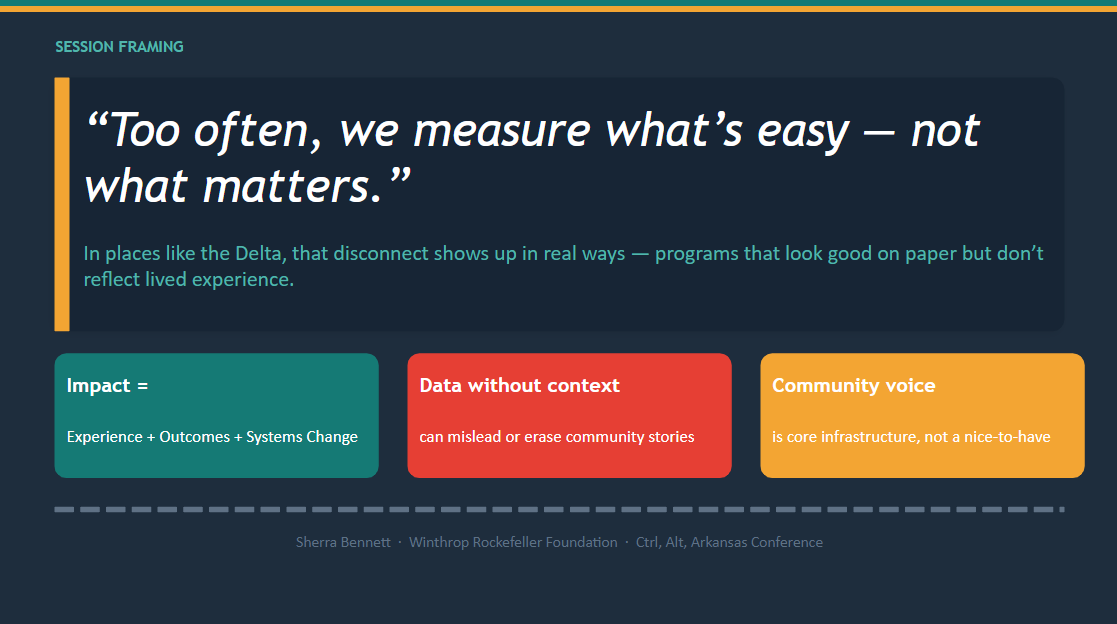
“Describe a time your organization measured something that looked great on paper but didn’t reflect what was actually happening.”
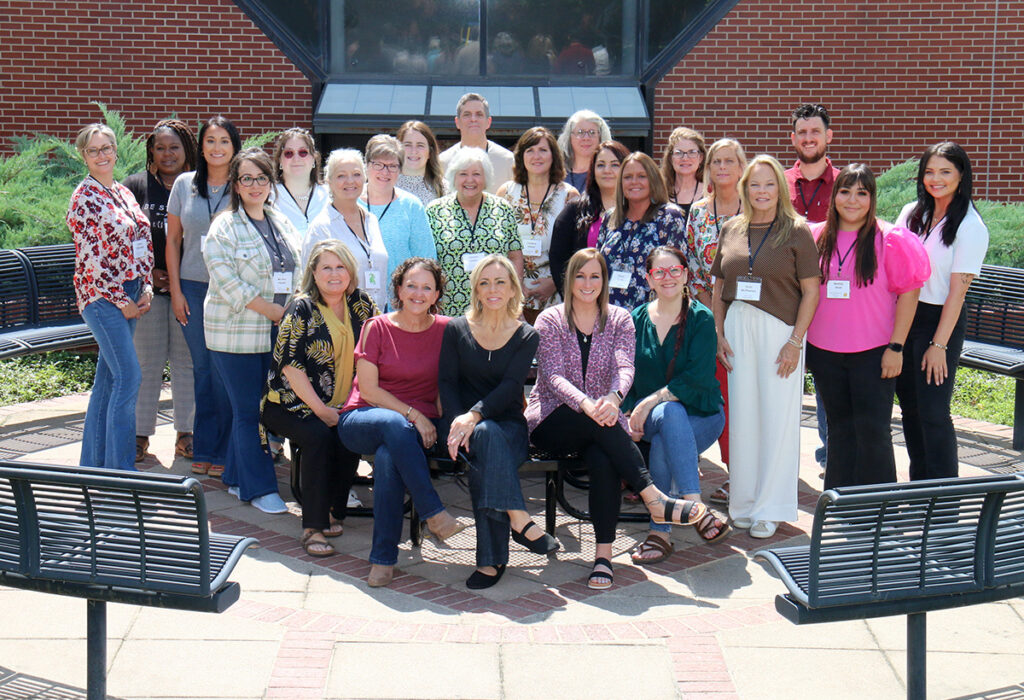
This is how Sherra Bennett, a senior program officer at the Winthrop Rockefeller Foundation, begins her presentation “Measuring What Matters.” Sherra presented best practices for measuring impact recently at the Arkansas Community Development Society (ACDS) and CDI Alumni Network conference, enlightening community leaders on how to effectively portray and utilize community data. This presentation highlighted the importance of contextualizing data, framing data to reflect lived experience, and centering community voice as core infrastructure for development.
In rural areas, especially in the Delta, accurately applying data is pertinent when population is dwarfed by that of more metropolitan regions. Bennett pays special attention to this. “Rural places will always lose the large number competition,” she said. With this in mind, rural leaders need to understand how to properly tell a compelling story through data. When pooling data from a smaller sample size, one must take special care in interpreting, presenting and acting upon the information gathered.
To successfully evaluate local impact, a good rule of thumb is to consider:
- Outputs (what you did): programs delivered, people served and/or events held
- Outcomes (what changed): improved stability, new skills, shifted behaviors, etc.
- Systems change (what shifted long-term): policies changed, power redistributed, equity advanced
“Your evaluation needs to reflect how people actually experience your work,” Bennett said. “Impact is not where you start—it’s where you finish. If your data doesn’t reflect lived experience, you’re missing the point.”
Bennett listed a few key methods to elevate information gathered to its highest potential. The first method is presenting data as percentages rather than as raw numbers. If an article details hundreds of families receiving assistance from a community program, it may be difficult for an audience to envision the impact of this program. When converting this data to a percentage—for example, framing it as “40% of local families”—it becomes much easier for the average person to gauge this impact.
She also provides three more useful techniques for aptly measuring impact: 1) improving outcomes to shrink disparities; 2) catalyzing policy change to shift systems, not just individuals; and 3) developing region-wide efforts where organizations/communities work together across boundaries. When these principles are prioritized, a community can make a more intentional effort to increase equity, ensure lasting change and build enduring cooperation.
Working regionally is of particular significance, and Bennett relayed the necessity of partnership, bridging silos and holding a multi-generational view. Silos are defined as groups or organizations that neglect sharing resources, information or objectives with one another. Without deliberate connection, silos can lead to general inefficiency and miscommunication. This can lead to the duplication of initiatives, underutilization of regional resources and neglect toward marginalized issues affecting the community. When bridges are built to overcome siloing, organizations can service their community in a maximized manner.
Local leaders are already applying these best practices and new knowledge in their communities. “Rural communities cannot always measure impact by the size of the number,” said Venesha Sasser, president and executive director of the Lafayette County Chamber of Commerce and Economic Development Commission. “Giving residents a meaningful role in defining success [is] part of the outcome. The information shared challenged me to be more intentional about measuring those changes.”
Bennett concluded that to tell a stronger story with data, the data should tell what happened, the story should tell why it matters, and sharing authentically can build trust locally and with funders. As we learn to frame data in a way that accurately tells our stories, we continuously grow closer to an optimized ideal of community development where the marginalized are no longer unsung and our resources are optimally dispatched.